



The coastal residential market continues to experience a period of strong activity. Sales and vacation rental prices maintain an upward trend, driven by demand that no longer responds only to interest in traditional second homes, but also to new lifestyle habits, wealth investment, and more flexible use of housing.
According to data published by Expansión based on a report by Pisos.com, the average purchase price of a home on the Spanish coast has grown by 14.2% year-on-year, reaching 322,350 euros. In the case of vacation rentals, the increase is even higher: 17.5%, with an average weekly rent of 1,142 euros.
These figures confirm the growing interest in the coastline, but they also highlight an important reality: not all areas evolve in the same way, nor do all transactions respond to the same logic.
Housing prices on the coast: differences by area
The coastal residential market is not homogeneous. Although the general trend is one of growth, the differences between areas are notable, both in purchase prices and rental rates.
In sales, the Balearic Islands and the Costa del Sol lead the increases, with rises exceeding 20%. These are highly consolidated markets, with a strong presence of international buyers, limited supply, and clearly premium positioning.
Other areas of the Catalan coast also stand out, such as the Costa del Maresme, with growth of 18.8%, the Costa Brava, with an increase of 17.4%, and the Costa Daurada, with a rise of 16%. These areas continue to attract buyers seeking quality of life, proximity to Barcelona, natural surroundings, and a product with medium- and long-term potential.
In contrast, the Costa del Garraf shows a different behavior. Despite being among the areas with the highest prices, growth in sales is only 0.9%. This figure does not indicate a loss of interest, but rather a very consolidated market, with high values and sustained demand that moderates the margin for growth.
Vacation rentals on the coast: prices, demand, and profitability
In the rental market, the trend is also clearly upward. The average weekly rent on the Spanish coast stands at 1,142 euros, 17.5% more than the previous year.
Some areas stand out especially for their rental levels. Garraf reaches an average of 1,830 euros per week, while the Costa Brava stands at 1,757 euros per week. These figures demonstrate the strength of the vacation market in certain locations, especially those with high tourist demand, good connectivity, and limited supply.
However, a high weekly rent does not necessarily equate to high profitability. In vacation rentals, many factors must be considered: seasonality, actual occupancy throughout the year, management expenses, maintenance, taxation, and the regulations applicable to each municipality.
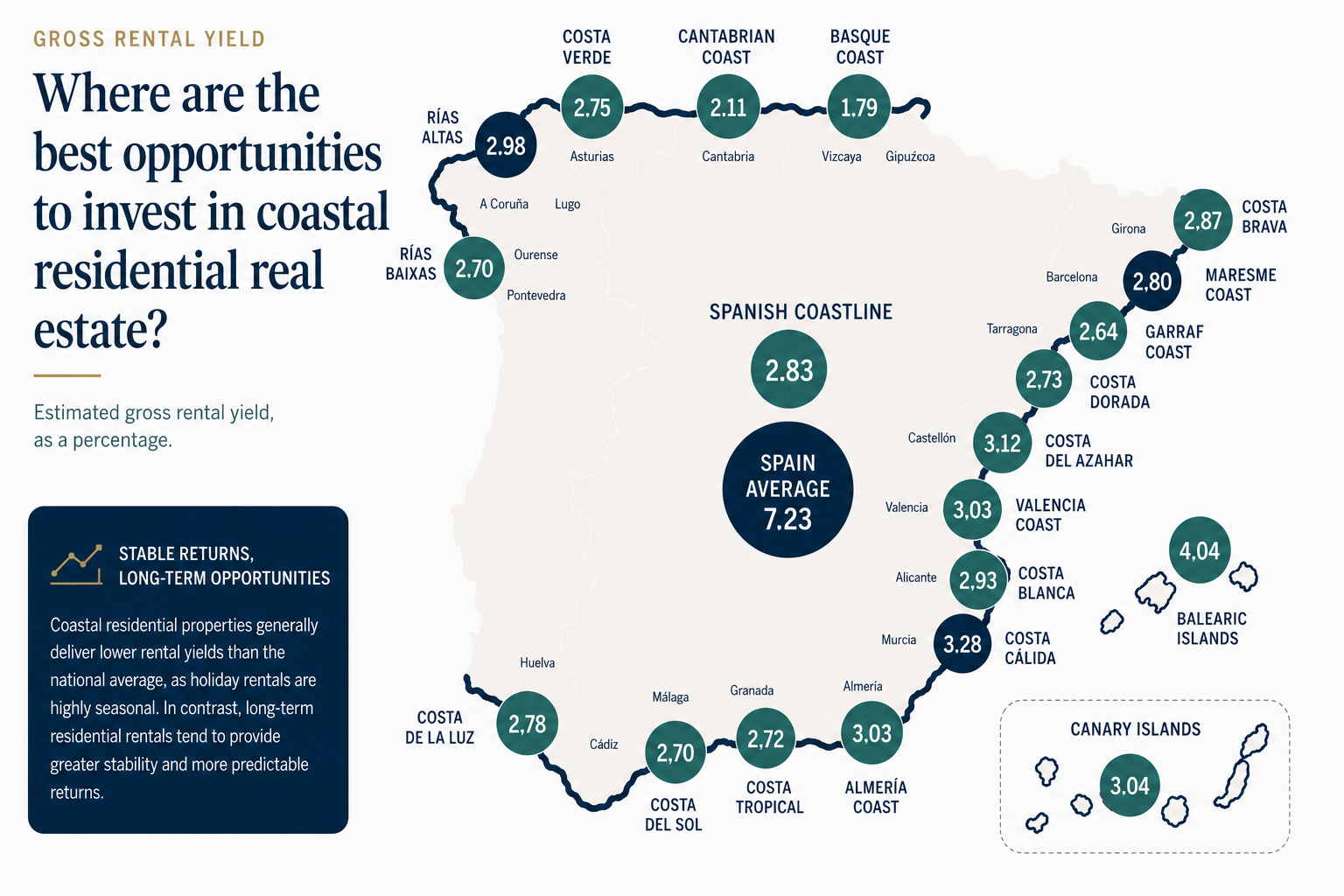
In fact, the report points out that average profitability on the coast is below the national average. This is partly due to the fact that many coastal markets have very high purchase prices and occupancy concentrated in certain times of the year.
Housing on the coast: from second home to wealth investment
One of the major changes in the coastal market is that many locations have ceased to be solely second-home markets. Today they combine very different uses: holiday housing, long stays, remote work, primary residence, wealth investment, and international demand.
This change responds to a broader transformation in the way of living and using housing. Following recent years, many buyers value outdoor space, proximity to the sea, quality of life, and the possibility of spending longer periods away from large cities.
In this context, certain coastal areas have gained appeal not only as summer destinations but as places to live for a good part of the year. This reinforces demand and helps to sustain prices, especially in markets with good connections, consolidated services, and quality residential supply.
Buying a home on the coast: what to analyze before investing
Faced with an expanding market, the temptation may arise to make decisions based only on the areas that are rising the most. But in real estate, and especially on the coast, this reading can be too simple.
A good decision does not only involve identifying the market with the highest year-on-year growth. It is necessary to understand what type of demand sustains that territory, what supply is available, what buyer profile predominates, and what real potential the asset may have in the medium and long term.
Buying in a premium and highly consolidated market is not the same as buying in an emerging area with room for growth. Nor is acquiring a home for own use the same as doing so with an investment or temporary rental strategy.
Each operation requires its own analysis: specific location, property condition, associated costs, local regulations, appreciation potential, and the buyer’s objectives.
The importance of a well-defined real estate strategy
In a market as dynamic as the coastal residential sector, information is key. Data helps to understand the direction of the market, but the final decision must be based on a personalized and realistic analysis.
For a buyer, this means assessing not only the entry price but also maintenance, taxation, future liquidity, and the property’s potential for use. For an owner, it may be a good time to analyze the current value of their asset and study whether it makes sense to sell, hold, or rethink the strategy.
The coast continues to be an attractive market, but also an increasingly demanding one. Limited supply, demand pressure, and vacation rental regulations mean that every decision requires judgment and knowledge of the territory.
Real estate investment on the coast: why a good strategy is necessary
The main takeaway is not just that “the coast is rising.” The real change is that the coastal residential market has become sophisticated. We are no longer just talking about second homes for the summer, but about assets with diverse uses, different demand profiles, and very unequal behaviors depending on the area.
Therefore, chasing the fastest-growing location is not always the best strategy. The most important thing is to understand what sustains that growth, what type of property is most in demand, and what potential the asset may have in the future.
At Llach Serra & Associats, we accompany every real estate transaction with a strategic, close approach adapted to each client. Whether it is selling, buying, or valuing an investment, analyzing the market well is the first step to making a decision with confidence.